Kilimanjaro Hike for NOOR
Join us for the Kilimanjaro Hike for NOOR from October 16–25, 2026, a meaningful challenge in support of Gaza’s orphaned children through NOOR, the largest Gaza orphan care program.
[email protected]
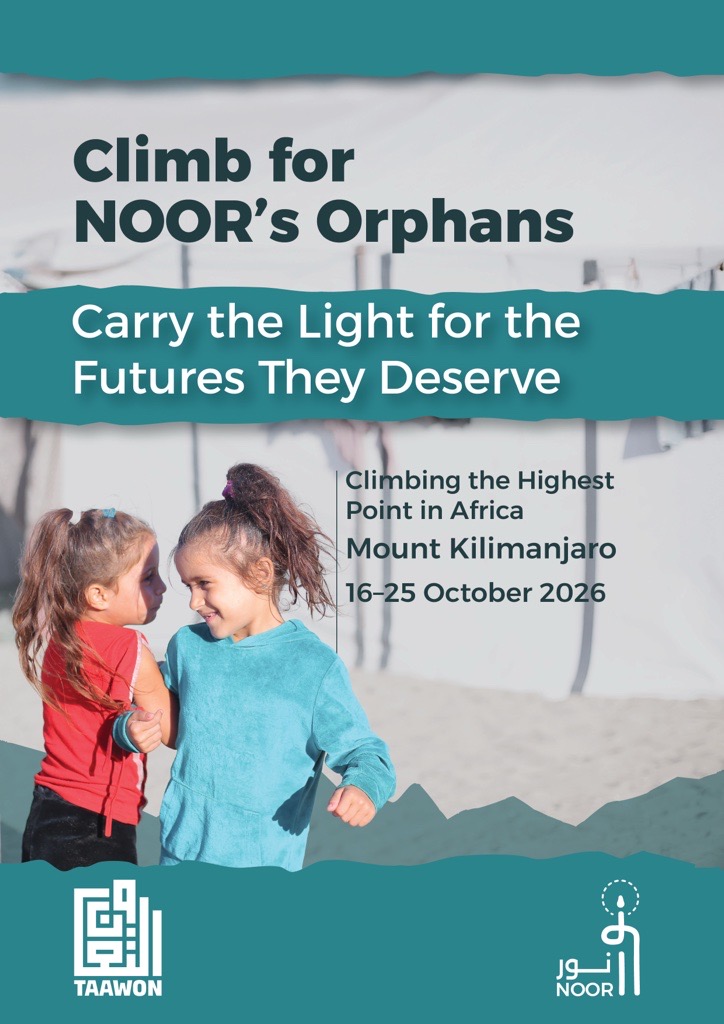
Why We Climb for NOOR
In October 2026, a group of NOOR (The Largest Gaza Orphan Care Program) supporters will climb Mount Kilimanjaro, not to conquer a mountain, but to carry light for children who have lost everything and still deserve a future filled with dignity, protection, and hope.
This climb is a promise.
A promise that orphaned children, whose lives were shattered by war and loss, will not be defined by what was taken from them. Through NOOR, we commit to restoring what matters most: care, stability, healing, education, and a future that is secure.
Every step upward reflects what these children face every day: steep odds, thin air, and the courage to keep going. Every step also carries NOOR, the light that represents protection and long-term commitment, not temporary relief. NOOR is built on the belief that children do not need sympathy. They need systems that stand by them for life.
Supporting this climb means supporting an 18-year promise to Gaza orphans, one that walks with them from early childhood through adolescence and into adulthood. It means investing in education, mental health and psychosocial support, social care, health, and humanitarian assistance, so that loss does not become destiny.
At the summit, above the clouds, we will carry their stories, their names, and their futures.
This climb is not about reaching the highest point in Africa. It is about ensuring that no child is left behind. We climb so they don’t have to. We carry the light for the future they deserve.
Meet Mostafa Salameh
Our hike leader is Mostafa Salameh, born in 1970 in Kuwait to Palestinian refugee parents who originate from Ramallah and Jaffa. He began his mountaineering journey in 2004, while living and working in Edinburgh. He had a dream that would change the trajectory of his life: he saw himself praying for peace from a mountain peak at the top of the world. Following that dream, Mostafa trained as a mountain climber, entering a world previously unknown to him.
He is the first Arab and one of 20 people in the world to complete the Explorers Grand Slam (Seven Summits including Mount Everest and the two Poles). Mostafa will be climbing Everest again for Gaza in May 2026.
Through mountaineering, Mostafa’s intention is to serve as a role model inspiring Arab youth to achieve whatever they set their minds to. He seeks to promote a positive global image of the Arab world and to inspire the younger generation to believe that anything is possible.
Mostafa is also an experienced motivational speaker who speaks at corporate organizations, non-profit organizations, schools and universities in Europe, the Arab world, North America and Asia.
Mostafa’s humanitarian initiatives to date have raised around $8.3 million. In 2008, Mostafa received the Medal of Independence from King Abdullah of Jordan and the Medal for Bravery in 2018. He was Jordan’s Sportsman of the Year for 2009 and participated in carrying the Torch in the winter Olympics in South Korea in 2017.
The Challenge: Mount Kilimanjaro
Mount Kilimanjaro is not only the highest peak in Africa, but also the tallest free-standing mountain in the world. Its summit, known as Uhuru Peak, rises to 5,895 meters (19,341 feet) above sea level. Kilimanjaro is a free-standing volcanic mountain formed as molten rock erupted and accumulated at the surface over time. Historically, it consisted of three volcanic cones: Kibo (5,895 m / 19,340 ft), Shira (3,962 m / 13,000 ft), and Mawenzi (5,149 m / 16,893 ft).
Located in Tanzania, just 205 miles south of the equator, Kilimanjaro occupies a region defined by intense solar radiation and stable year-round temperatures. Equatorial climates tend to be consistently warm, shifting between wet and dry patterns rather than seasonal changes. When early explorers reported seeing glaciers atop Kilimanjaro, many doubted their accounts believing ice could not exist so close to the hot equatorial sun. Today, scientists know that Kilimanjaro’s glaciers have expanded and retreated multiple times, particularly during global ice age cycles.
Event Visuals


Our Route
We will climb the Marangu route, which is the oldest route and often considered the most straightforward. It is nicknamed the “Coca Cola” route, as it is popular and attracts a larger number of climbers than other routes. It approaches Kilimanjaro from the southeast and passes through beautiful rainforest and moorland.
The ascent on this route is constant and moderate, and the trekking is relatively relaxed compared to sections of other routes. This is a good bet for those concerned about their fitness. Marangu has good paths and gradual tracks. However, the continuous ascent results in a poorer acclimatization profile. In contrast to the other routes, we stay overnight in mountain lodges, as opposed to sleeping in tents. We ascend and descend on the same route.
Itinerary
16th October
Arrive at Kilimanjaro International Airport.
You will arrive in Tanzania and then take a 50-minute transfer to the hotel in Arusha. The 5-star hotel provides great facilities needed for the stay. Our staff will be waiting for you outside the terminal with a sign “Mostafa Salameh Adventures”.
Welcome Dinner17th October
Arusha rest day and gear check. Full day safari and a visit to the Masai village.
BreakfastLunch18th October
Trek Marangu Gate to Mandara Hut (8,858ft / 2,700m).
Walking Time: 4-5 hours. Distance: 7km. We will have breakfast at 7am and leave the hotel by 8am. You will begin your journey to the summit of Mount Kilimanjaro after completing the gate registration. A great length of the hike is spent venturing on a narrow trail enclosed by evergreen rainforest.
Reaching Kisambioni is a milestone at the halfway point of the trek. We will sit down and enjoy a picnic lunch. We will continue walking through the rainforests of Kilimanjaro after lunch. Our destination is the Mandara Hut. Once we arrive you can decide whether you want to relax for the rest of the day or take a leisurely stroll to the Maundi Crater. You will spend the night in the A-frame Mandara Huts which accommodate up to seventy people and feature beds with mattresses. There are several sleeping huts and a dining area, each two people will share one hut.
BreakfastLunchDinner19th October
Mandara Hut (8,858ft / 2,700m) - Acclimatization Day / Rest.
Elevation Gain: 700 meters (2,200 feet). Walking Time: 3-4 hours. Distance: 5km. After breakfast, we start the climb through the rainforest towards the giant moorland zone 3,200m.
BreakfastLunchDinner20th October
Mandara Hut to Horombo Hut (12,140ft / 3700m).
Elevation Gain: 977 meters (3,200 feet). Walking Time: 6-7 hours. Distance: 11km. We will start heading towards Horombo Hut after breakfast. The environment will shift drastically as the route requires us to travel through Mount Kilimanjaro's moorland, a rock-strewn desert plain with succulent plants. There will be a picnic lunch at Kambi ya Taabu during the hike. If the skies are clear you will have a chance to witness the scenic views of the Mawenzi and Kibo peaks.
We will arrive at the Horombo Huts at approximately 3:00pm and the afternoon can be spent relaxing. The Horombo Huts are exceptionally busy but they’re considered to be the finest huts on Mount Kilimanjaro. The little A-frame huts can house a maximum of eight people and provide suitable lodging for hikers ascending, descending and acclimatizing. They can accommodate a maximum of 120 hikers with additional room for porters, chiefs and guides.
BreakfastLunchDinner21st October
Horombo Hut (12,140ft / 3700m) - Acclimatization Day / Rest.
Elevation Gain: 700 meters (2,200 feet). Walking Time: 3-4 hours. Distance: 5km.
BreakfastLunchDinner22nd October
Horombo Hut to Kibo Hut (15420ft / 4700m).
Elevation Gain: 1,030 meters (3,380 feet). Walking Time: 6-8 hours. Distance: 10km. After breakfast we will hike through the moorland and the alpine desert region of Mount Kilimanjaro. After hiking for about an hour we will encounter a small mountain stream called the Maua River. Once you pass Maua you will notice that the terrain gets smoother and the vegetation starts to diminish. We will have lunch at the Middle Red Hill. We will continue our trek shortly after lunch and spend the next hours traveling to Kibo on a steady incline through Mount Kilimanjaro's Saddle.
The silver lining to traveling through a barren desert is the stunning vista of the Kibo and Mawenzi peaks. You will reach the Kibo hut in the afternoon. It is recommended that you rest and prepare for your midnight climb.
BreakfastLunchDinner23rd October
Kibo Hut to Summit to Horombo Hut.
Elevation Gain: 1,145 meters (3,760 feet). Elevation Loss: 2,175 meters (7,140 feet). Walking Time: 11-13 hours. Distance: 18km.
The final leg of your journey is the ascent to Uhuru Peak, ‘The Roof of Africa’. We will leave shortly after midnight and begin with the strenuous five-hour hike to Gillman's Point on the crater rim. This is considered to be the least challenging of the three crater ascent paths, but it is still an arduous hike. William’s Point is the first major rest stop, and it usually takes two hours from the Kibo Hut to arrive at the five-thousand-meter mark.
After thirty minutes of hiking you will reach the rocky bends and twists that continue for over six hundred meters or until you reach Gillman’s Point. The incline from Gillman's Point to Uhuru Peak increases gradually. You will feel tired and this part will take long due to the high altitude. The crater rim hike will last about two hours. Once you reach the summit, we have allocated time for photographs and celebration. We will start descending to Horombo Hut - our final stop on the route. The route down the summit has magnificent views that you could not see when you were climbing. You will have a chance to stop at the Kibo Hut to recollect yourself and enjoy energy dense snacks. We will reach the Horombo Huts in the afternoon and you can spend the time enjoying your last moments on the mountain.
BreakfastLunchDinner24th October
Horombo Hut to Marangu Gate to Arusha.
Elevation Loss: 1,920 meters (6,295 feet). Walking Time: 5-6 hours. Distance: 19km. We will finish the trek by descending to the Marangu Gate after breakfast. The final hike is simply magical. You will hike amid Mount Kilimanjaro's tranquil cloud forest. We advise that you watch your step as the trail can be slippery. Our vehicles will be waiting at Marangu Gate to drive you back to Arusha. You will have an opportunity to buy sodas and souvenirs to prove that the route was conquered. After a welcome lunch it's time to say “kwaheri” to the porters. We then get a lift back to the hotel and a well-deserved shower and a celebratory drink.
BreakfastLunch25th October
Leave Africa.
Thank you for being a major part of carrying the light for the futures the NOOR orphans deserve!!!
BreakfastTips for a Successful Climb
There are some important points to bear in mind when ascending Kilimanjaro. Our guides provide advice on the best approaches to take and inform you about the services you can expect to receive while on Kilimanjaro. It also advises health considerations and tells you what will happen if you become unwell. While it is helpful to learn what works best, you can also take assurance from the fact that your guides will be experts in mountain-climbing and have an intimate knowledge of Mount Kilimanjaro. You will be in safe hands throughout the whole experience.
Take it Slow and Easy
Trekking at a slow and steady pace is your best defense against Kilimanjaro’s biggest challenge: altitude. Holding back helps your body acclimatize to the increasing height, lower oxygen levels, and dropping temperatures. A slow speed also helps you maintain stamina for your walking days and use energy efficiently. Your guides know the best pace and you should heed their advice.
Eat and Drink Well
Even though appetite is likely to decline at high altitude, it is important to eat adequately. The cold environment and constant walking mean that your body will need plenty of energy. Drinking well is essential; at high altitude it is easy to become dehydrated without noticing. You should aim to drink at least 3-4 liters of water per day.
Travel Light
While you must bring everything you need for your climb, try to carry as little weight as possible in your day pack. A greater mass on your back means walking will demand more effort and breathing the thinner mountain air will feel more of a strain.
Guides and Porters
Our guides will take care of you during the entire journey up and down Kilimanjaro. They are friendly, helpful, fluent in English, and will ensure that you are feeling well while providing advice and inspiration. The guest-to-guide ratio never exceeds 3:1. A porter will transport most of your luggage up to a maximum weight of 15kg, leaving you to carry only a backpack with accessible essentials.
Food and Drinks
During your climb, you will be provided with wholesome, tasty meals prepared by accompanying chefs. Meals are designed to provide strength and energy. You will also be supplied with boiled water and hot drinks including tea, coffee, and drinking chocolate. You may bring favorite snacks, energy drinks, or concentrated drinks for sterilized water. Meals will be appropriate to the stage of ascent.
Advice on Tipping
Deciding whether to offer gratuities to the staff assisting during the climb is a matter of personal discretion. Guests often wish to express appreciation through a tip. If you may wish to tip, carry extra cash during the climb. It is customary to present the tip at the end of the descent to the head guide, who will distribute it among the staff.
Health and Safety
Even when you have taken on board the best advice about how to protect your body against the strain of climbing Kilimanjaro, it is highly likely that you will experience some degree of physical discomfort during the climb. As you progress up the mountain, the effects of altitude will be apparent in feeling short of breath, and perhaps in headaches and mild nausea.
We take special measures to monitor the health and wellbeing of the team during a climb. Our guides use pulse oximeters twice daily to check blood oxygen levels to prevent potential altitude sickness or AMS (acute mountain sickness). They also record everything from blisters to any drugs you might be taking to keep abreast of your physical condition. This precautionary approach has earned Mostafa Salameh Adventures a reputation for being an outstanding provider of health and safety protection.
Although our experienced guides take these thorough precautions to monitor guests and encourage gentle acclimatization, the risk of altitude sickness is always present. Fortunately, our guides are experienced in dealing with this scenario and are well-equipped to offer the right medical assistance. They carry Gamow bags, oxygen cylinders, and drugs which can be employed if needed. Guides may also take you back down to a lower altitude temporarily to help the body adjust.
In extreme cases of altitude sickness, it may be necessary to abandon a summit attempt altogether and be escorted back down the mountain. Please note that the head guide will be responsible for making the decision as to whether it is safe for a guest to continue a climb, and that this decision must be accepted.
Training and Fitness
Climbing Mount Kilimanjaro is a physical challenge that is well within the reach of most people who enjoy a reasonable level of fitness. However, training specifically for the climb is essential to prepare you for the difficulties posed by mountain walking.
It is recommended to seek medical advice prior to deciding to apply for the climb and before starting a training program, particularly if you have any concerns about your health. Your doctor will also be able to advise on the vaccinations required ahead of travel to Tanzania. Yellow Fever certificate is a must. It is sensible to start training 3-6 months before your climb.
Conventional exercise routines that build strength, fitness and stamina, such as aerobics and light weight-training can be beneficial, particularly if your fitness level is less than desirable. But the best physical preparation is activity which simulates, as far as possible, the demands on your body during your ascent and descent of Kilimanjaro.
You should therefore aim to make walking the main part of your training. Taking regular and increasingly long walks will help develop the muscles needed when you arrive in Africa. Try to find local hills to walk up and down if possible. Gradually increasing the duration of your walks will help develop stamina and prepare you for being on your feet over long distances.
When out on training walks, always wear the boots you intend to take to Kilimanjaro. Getting used to your footwear will help make you as comfortable as possible when it comes to your climb. It is also a good idea to wear the small day sack you will take on the climb to ensure it is comfortable.
Being mentally prepared will also be crucial to your chance of a successful summit climb. Progressively pushing the limits of your physical training will help develop your capacity to endure the strain. A positive attitude is also crucial. It is helpful to remind yourself when training and during the climb that thousands of people have achieved this feat before you and that you can do it too. Be prepared for setbacks and difficult stages, and remember that your guide will be there to encourage and inspire you.
Trip Cost
Kilimanjaro Climb + 1 Day Safari & Masai Village
USD 5,500Payment Terms
- USD 1,800 non-refundable deposit due with registration form.
- Deposit must be paid by February 10th.
- Check registration form for due date of balance.
What the Price Includes
- National Park fees and peak permits.
- All internal hotel/airport transfers.
- Hotel accommodation in Arusha on a twin-sharing basis.
- All road transport by private vehicles.
- All camping facilities and meals during the trek.
- All costs for Tanzanian guides, cook staff, camp crew and porters, not including tips.
What the Price Does Not Include
- International round-trip fare.
- Visa fees.
- Personal gear, clothing and sleeping equipment.
- Insurance. A comprehensive medical insurance policy is required to embark on this expedition.
- Alcoholic beverages and bottled drinks.
- All expenses incurred in the event of early departure, including evacuation fees, transport, extra hotel nights, etc.
- Personal items including personal medical kit.
- Travel insurance.
- Tips, estimated at US $300.
- Extra porters to carry your small backpack or cameras.
- Internet and WIFI.
- Excess baggage.